Most of the people who fail the Georgia electrical contractor exam did not fail on transformers. They walked into Part 1, 30 questions on laws, regulations and running a business, four hours before they saw a single code question, and found out that "open book" only helps if you brought the right book and know where the number is.
Here is the whole of Part 1, category by category, with the PSI counts and the numbers that come up. Every one is written from the Georgia Code, the Board rules or the federal source, and the lesson it comes from prints the date it was read.
A. Comply with laws: 10 questions
Six named topics share these ten.
Workers' compensation (O.C.G.A. 34-9). The act applies to every employer with three or more employees regularly in service, part-timers counted. The employee reports the accident within 30 days; you file the employer's first report (WC-1) within 10 days for any injury that needs treatment or costs more than seven days of work. Temporary total disability pays two-thirds of the average weekly wage, capped at $800 a week for accidents on or after July 1, 2023, for up to 400 weeks. A general contractor is the statutory employer of an uninsured sub's crew, which is why the general asks for your certificate.
Unemployment insurance (O.C.G.A. 34-8). You are a liable employer once you have paid $1,500 or more in wages in a calendar quarter or had at least one worker in each of 20 weeks. Contributions are due quarterly on the first $9,500 of each employee's wages. New employers pay 2.64 percent through December 31, 2026 (the statutory standard rate is 2.7 percent), plus a 0.06 percent administrative assessment.
Circular E (IRS Publication 15) and Georgia withholding. Federal deposits are monthly or semiweekly by lookback; Form 941 quarterly; Form 940 annual. Georgia withholding runs on Form G-4 and the Department of Revenue tables, filed quarterly, monthly or semiweekly by the amount withheld. Every new hire or rehire is reported to the Georgia New Hire Reporting Center within ten days.
The Licensing Board (O.C.G.A. 43-14). Class I is residential single-phase up to 400 A under the statute re-enacted July 1, 2026 (the old Board rule says 200 A). Three years of experience for Class I, four with two on three-phase for Class II. Licenses renew every two years by June 30 of even-numbered years; four CE hours a year. Unlicensed contracting is a misdemeanor, up to $1,000 and six months.
Sales and use tax (O.C.G.A. 48-8). The contractor is the consumer of the materials it installs: pay sales tax to the supplier at purchase, or use tax if the supplier did not collect it. State rate 4 percent plus local. Do not hand a supplier a resale certificate for job materials. A nonresident contractor on a Georgia job registers the contract and posts a bond, or the general withholds.
Business license (O.C.G.A. 48-13). The occupation tax is levied by the city or county where you keep an office, measured by gross receipts, employees or a flat fee, with the E-Verify affidavit at renewal.
B. Comply with regulations: 9 questions
OSHA 29 CFR 1926. Subpart K is the electrical standard: 1926.402 through .408 for installations, .416 and .417 for work practices, .431 through .441 for tools and batteries. OSHA's numbers mostly match the NEC's, and the exam likes the places where OSHA says it in its own words: lockout and tagging, approach distances, GFCI or an assured equipment grounding conductor program on temporary power, the 1904 recordkeeping and the reporting clock (a fatality within 8 hours; an in-patient hospitalization, amputation or eye loss within 24).
The NEC and Georgia's adoption of it. The Uniform Codes Act makes the NEC a mandatory statewide code, adopted by DCA. The edition is 2023 with Georgia amendments; the 2026 amendments take effect January 1, 2027 and do not change the edition. A local amendment must be at least as stringent and go to DCA 60 days before adoption. How the NEC is organised (chapters 1 through 4 apply generally, 5 through 7 modify, 8 stands alone, 9 is tables) and Article 110's general requirements sit here too.
NFPA and UL. Which NFPA document is which (70, 70E, 72, 101), and what a listing mark means: the AHJ accepts equipment listed by a nationally recognised testing laboratory, and 110.3(B) makes the listing instructions enforceable.
Permits and inspections (O.C.G.A. 8-2-26). The local government that enforces the state codes may require permits, set the fees, employ inspectors and set an appeal process; the inspector cannot hold you to a code the Act does not cover.
C. Comply with administrative requirements: 6 questions
Bonds (O.C.G.A. 13-10 and 36-91). On Georgia public work, a bid bond of not less than 5 percent is required when the estimated bid is over $100,000, and a performance bond of at least 100 percent of the contract when the amount is over $100,000. The payment bond is the sub's substitute for a lien, because public property cannot be liened. Federal work follows FAR Part 28 at 100 percent.
Insurance. General liability, property damage, auto, builder's risk, and the certificate of insurance the general demands before you set foot on site.
Cash flow and the Prompt Pay Act (O.C.G.A. 13-11). The owner pays within 15 days of a proper pay request; the contractor pays each sub within ten days of being paid. Retainage, progress billing and the schedule of values are the vocabulary.
Bookkeeping, financial statements and job costing. Balance sheet, income statement, cash-flow statement, the ratios (current ratio, working capital), overhead and markup versus margin, break-even. The exam gives a small table and asks for one number.
Accident and incident reports, estimating and bidding, contracts and purchase orders. Takeoff, labor units, overhead recovery, bid documents; contract types, indemnity, lien rights (O.C.G.A. 44-14), UCC delivery terms.
D. Plan and organize work: 5 questions
Reading drawings and specifications for the submittal process (what a submittal is, who approves it, what "or equal" means), inventory control of equipment, materials and supplies, and scheduling: bar charts, the critical path, float. Five questions, usually the easiest five in Part 1 if you have run a job.
What to bring, and what you cannot
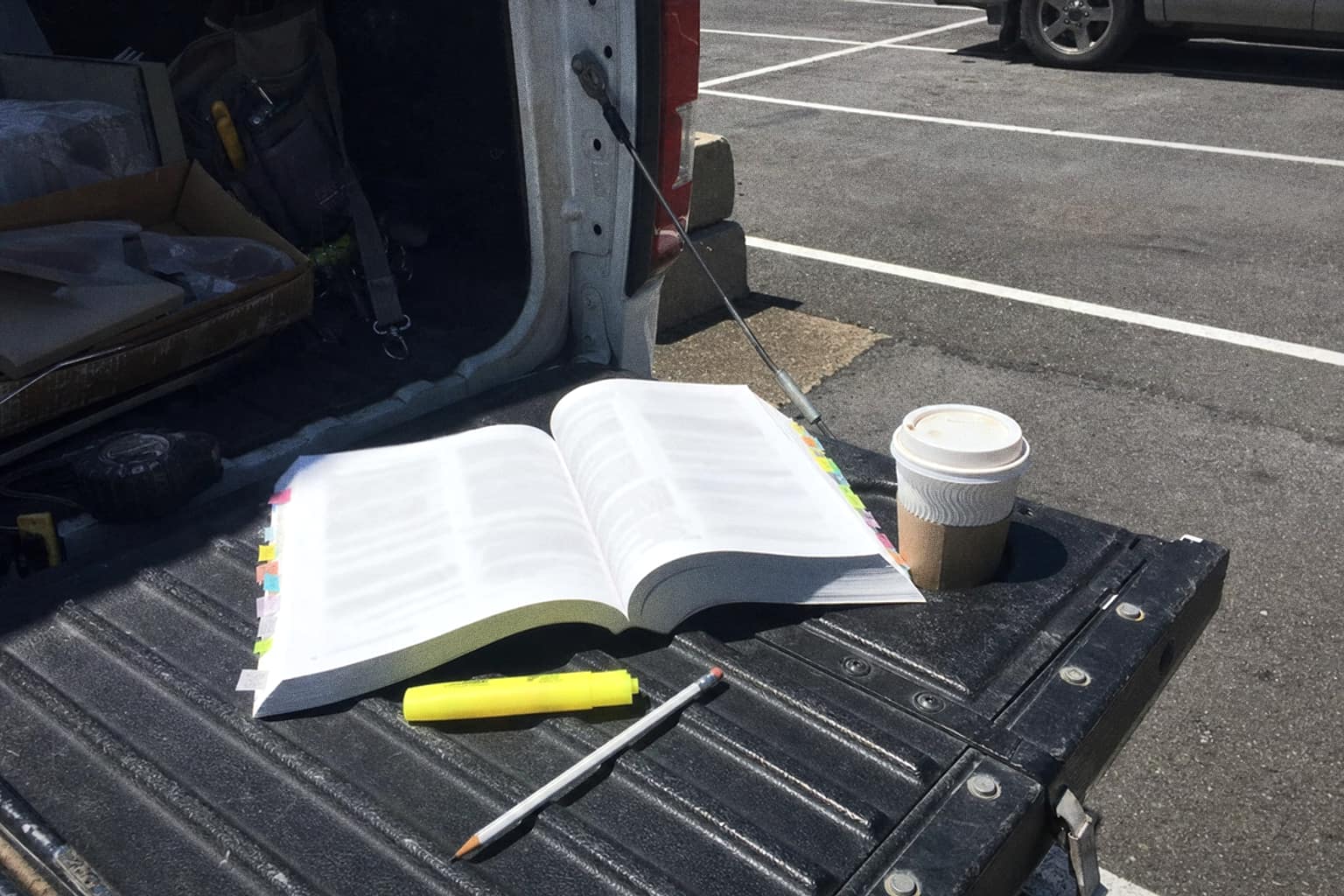
Part 1 is open book, but the Georgia Code is not on PSI's reference list. The NASCLA Contractors Guide to Business, Law and Project Management, Georgia CILB edition is, and it reprints the statutes and Board rules the exam draws on. So is Circular E. Tab both. Everything else in Part 1 you carry in your head, which is why the numbers above are the study list.
Our Part 1 bank is 22 lessons and 480 questions across the four categories, each cited to the O.C.G.A. section, the Board rule or the federal source. The free 20-question exam includes Part 1 items, and the Class II exam guide has the full outline with counts.